
What is Tithi? Meaning, Calculation, Types, and Importance in the Hindu Calendar
This guide explains Tithi in simple language — its meaning, calculation, connection with the Moon and Sun, role in Panchang, and why it is important for Hindu festivals, fasting days, worship, and auspicious timings.
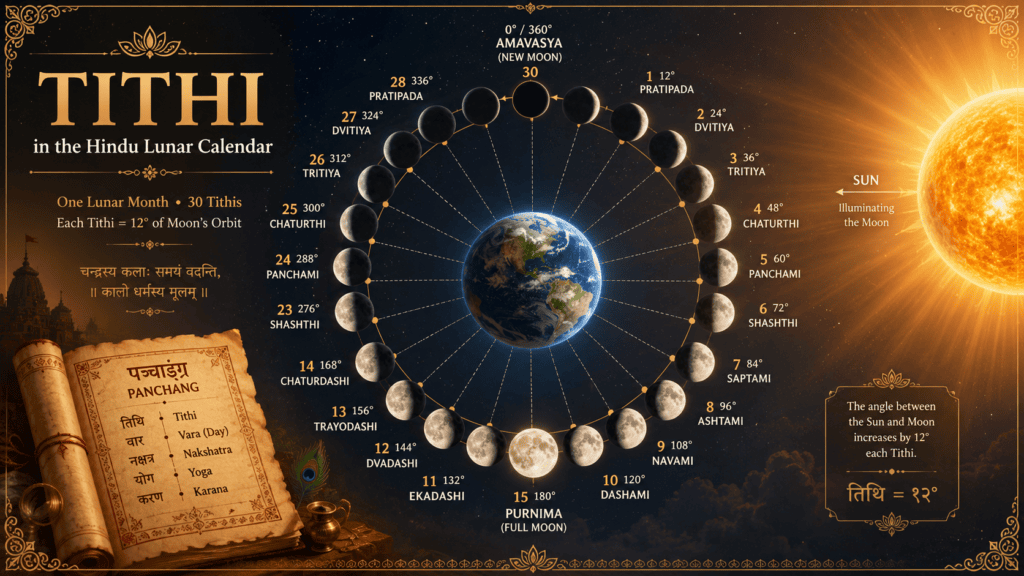
When I first tried to understand Tithi, the simplest way that worked for me was not to treat it like a normal date, but as a lunar day. The Sanskrit word Tithi is connected with the movement of the Moon from the Sun, and it is different from samasthiti, which means balanced stillness. In practical terms, a Tithi begins when the longitudinal angle [angular distance] between the Moon and Sun increases by 12 degrees. This time duration is counted through consecutive epochs [successive time points], where every integer multiple of 12 degrees creates the next lunar division. This is why the Panchang, also called the Hindu calendar or traditional Hindu calendar, is not just a date sheet; it is an ancient time reckoning system used in Vedic astrology to understand Hindu festivals, daily activities, and important occasions. The Panchang is built on five limbs or five attributes: Tithi, nakshatra, Vara, Yoga, and Karana, all strongly linked with Moon motions and other heavenly entities seen from Earth.
The Moon takes a clockwise orbit around Earth, completing a 360 degree circle in roughly one lunar month. Around the new moon phase, only a thin crescent may be seen, because a small part of the illuminated hemisphere reflects sunlight toward Earth. As the Moon moves through the sky direction away from the Sun, the bright crescent grows and the lunar cycle continues. But the actual tithi duration is not fixed like a civil day. Sometimes there can be a same day tithi, sometimes an overlapping tithi, and sometimes the same tithi appears on consecutive days. A tithi may stretch up to 26 hours, or be as short as 21 hours 34 minutes 24 seconds, because the Sun and Moon do not move at one uniform speed. There are 15 tithis in the waxing cycle, called Shukla Paksha, and 15 in the waning cycle, called Krishna Paksha. Amavasya, known as no moon or new moon, happens when the Sun and Moon have equal longitudes. After that, when the Moon moves 12 degrees away from the Sun, Pratipada Tithi begins; the second tithi covers the next 12 to 24 degrees. Purnami Tithi or Purnima marks the full moon side of this rhythm, while many other tithis are named through Sanskrit numbers.
In Indian tradition, Tithi is used to choose a muhurta, including an auspicious muhurta for good work or avoiding an inauspicious muhurta when needed. In Hindu religion, it affects worship, religious vows, prayers, and celebration. There are twelve Purnima days in a year; Guru Purnima falls on the full moon day of Ashadha, known as Aadi month in the Tamil calendar, and it honours spiritual teachers, traditional teachers, and gurus according to Hindu customs. Akshaya Tritiya, also called Akti or Akha Teej, is a Hindu spring festival on the third tithi of the bright half of Vaisakha, known as Vaikasi month, and is treated as an auspicious day connected with never ending prosperity. Ekadashi Tithi, the eleventh lunar day of the two lunar phases, is sacred to Lord Vishnu, when devotees may keep a strict fast, break it after sunrise, and follow fasting without water or fruit fasting. Many Indian festivals and the birthdays of deities follow the lunisolar calendar: Lord Rama birthday falls on Shukla Navami Tithi of Chaitra, called Chithirai, while Lord Krishna birthday falls on Krishna Ashtami Tithi of Shravana month, called Avani month. Even today, some families prefer a birthday by tithi, or check ancient Vedic astrology before entering a new house, starting a business beginning, or doing any good deed, because they believe the universe reflects timing with intention. In Vedic timekeeping, Tithi is also described as the two faces of moon observed from Earth, known as mīlālyā or milalya in Newar and Nepal Bhasa, and its changing nature explains why it can begin at varying times of day.
There are 30 Tithis in one lunar month:
- 15 Tithis in Shukla Paksha — waxing phase, from New Moon to Full Moon
- 15 Tithis in Krishna Paksha — waning phase, from Full Moon to New Moon
| No. | Shukla Paksha Tithi | Krishna Paksha Tithi |
|---|---|---|
| 1 | Shukla Pratipada | Krishna Pratipada |
| 2 | Shukla Dwitiya | Krishna Dwitiya |
| 3 | Shukla Tritiya | Krishna Tritiya |
| 4 | Shukla Chaturthi | Krishna Chaturthi |
| 5 | Shukla Panchami | Krishna Panchami |
| 6 | Shukla Shashthi | Krishna Shashthi |
| 7 | Shukla Saptami | Krishna Saptami |
| 8 | Shukla Ashtami | Krishna Ashtami |
| 9 | Shukla Navami | Krishna Navami |
| 10 | Shukla Dashami | Krishna Dashami |
| 11 | Shukla Ekadashi | Krishna Ekadashi |
| 12 | Shukla Dwadashi | Krishna Dwadashi |
| 13 | Shukla Trayodashi | Krishna Trayodashi |
| 14 | Shukla Chaturdashi | Krishna Chaturdashi |
| 15 | Purnima / Purnami | Amavasya |