
Purnima vs Amavasya: Meaning, Rituals, Energy, and Spiritual Difference?
Purnima and Amavasya are two important lunar points in the Hindu calendar, marking the Full Moon and New Moon.
Purnima represents fullness, visibility, devotion, and heightened energy, while Amavasya represents silence, reflection, ancestors, and inner reset.
Together, they show how the Hindu lunar calendar connects moon phases with rituals, emotions, spiritual awareness, and daily life.
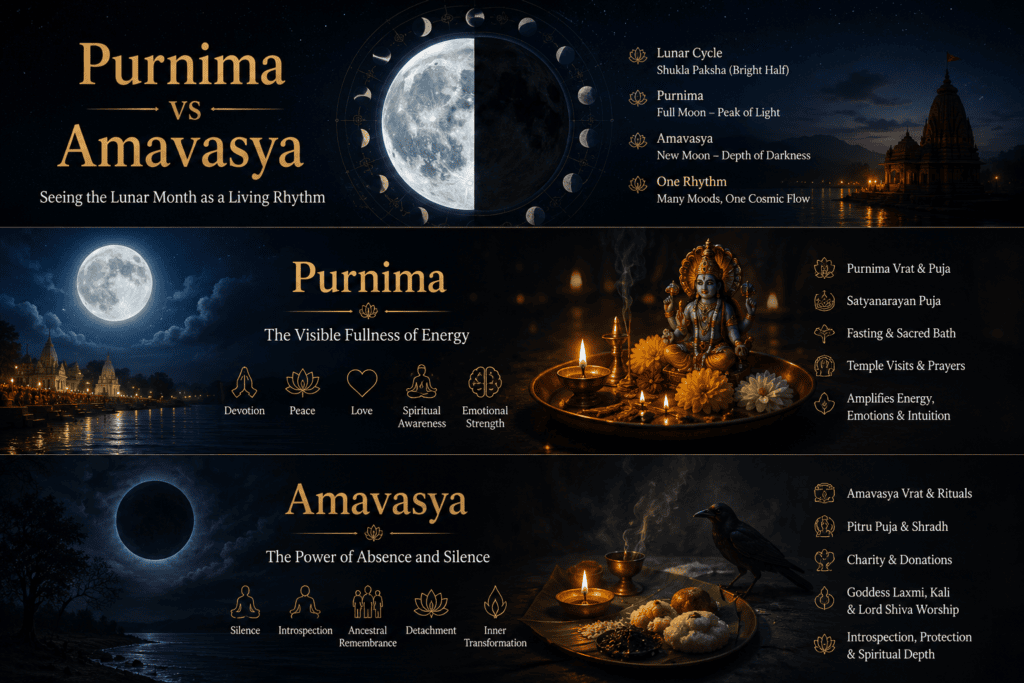
The Lunar Rhythm Behind Purnima and Amavasya
The easiest way I explain Purnima vs Amavasya is not as a simple comparison between Full Moon and New Moon, but as two opposite moods of the same lunar cycle. In the Hindu calendar, both are deeply connected with Panchang, Tithi, Paksha, and the movement of the Moon through one lunar month.
Purnima, also called Pournami or Poornima, is the full moon day, when the Moon is fully visible. Amavasya is the new moon night, when the Moon disappears from normal sight. Between these two points, the lunar phase, moon phase, and moon visibility keep changing. This is why traditional life in India never looked at the Moon only as an object in the sky. It was treated as a guide for natural rhythm, cosmic rhythm, and sacred rhythm.
In one month, the bright half is called Shukla Paksha, and the dark half is called Krishna Paksha. Purnima comes at the peak of Shukla Paksha, while Amavasya comes at the end of Krishna Paksha. This is the basic structure behind many Hindu rituals, religious observance, fasting, festivals, and spiritual timing.
Purnima: Why the Full Moon Feels More Energetic and Peaceful
On Purnima, the presence of moonlight creates a different atmosphere. Many people describe this day as having heightened energy or amplified energy. I have personally noticed that temple visits, group prayers, and night walks feel more open on full moon nights. The mind becomes more responsive, and emotions can feel larger than usual.
This is why Purnima Vrat, Puja, Satyanarayan Puja, devotional worship, prayer, and spiritual practice are common on this day. Devotees worship Lord Shiva, Lord Vishnu, and other deities depending on family tradition. Some observe fasting rules, follow Purnima Puja Vidhi, take a sacred bath in a sacred river, or visit a temple.
The full moon is often linked with peacefulness, joy, love, beauty, aesthetic quality, receptivity, and spiritual awareness. But it can also increase emotional intensity, mental sensitivity, and impulsive behavior. So, Purnima is not only “good” in a casual sense. It magnifies what is already present inside a person.
This is also why traditional systems connect Purnima with lunar energy, intuition, consciousness, inner balance, and emotional balance. In yogic language, the lunar side is often associated with Ida, while the solar side is associated with Pingala. Their balance affects prana, or life energy, and deeper practices may also speak of kundalini, subtle energy, and spiritual energy.
Amavasya: Why the New Moon Is Linked With Silence and Ancestors
Amavasya works differently. It is not about visible brightness but about darkness, silence, and inward movement. Since there is no visible Moon, the night carries a feeling of inner absence. For some people, this can create heaviness. For others, it becomes a powerful time for meditation, silence, and self-observation.
Traditionally, Amavasya Vrat, Amavasya ritual, ancestor worship, Pitru rituals, Shradh, and ancestral remembrance are important on this day. Families offer food offering, remember forefathers, seek ancestors’ blessings, and sometimes feed crows, needy people, or poor people as an act of charity and donation.
In many homes, Amavasya is also connected with household cleaning, prayers to Goddess Laxmi, and protection-based worship of Goddess Kali or Lord Shiva. Some traditions avoid auspicious work, new beginning, major important decisions, and unnecessary night travel. This does not mean everyone should fear Amavasya. It means the day is treated with caution, discipline, and awareness.
At the same time, Indian tradition also connects Amavasya with Tantra Mantra, occult practices, and black magic. These are part of older belief systems around powerful nights, hidden forces, and intense spiritual work. A practical reader should understand this as cultural and religious belief, not as a reason for blind fear.
How Purnima and Amavasya May Affect Body, Mind, and Emotions
One reason people take Purnima and Amavasya seriously is the Moon’s relation with water and the body. The Moon is associated with gravitational pull, tides, and water influence. Since the human body contains a large amount of water, many traditional explanations connect lunar days with blood circulation, brain activity, body balance, mind balance, and soul balance.
In spiritual language, solar energy is often seen as active, sharp, and outward, while lunar energy is softer, reflective, and inward. On Purnima, the full lunar presence may increase spiritual sensitivity, emotional sensitivity, and human emotions. On Amavasya, the absence of Moon can deepen silence, but also make some people feel unstable or withdrawn.
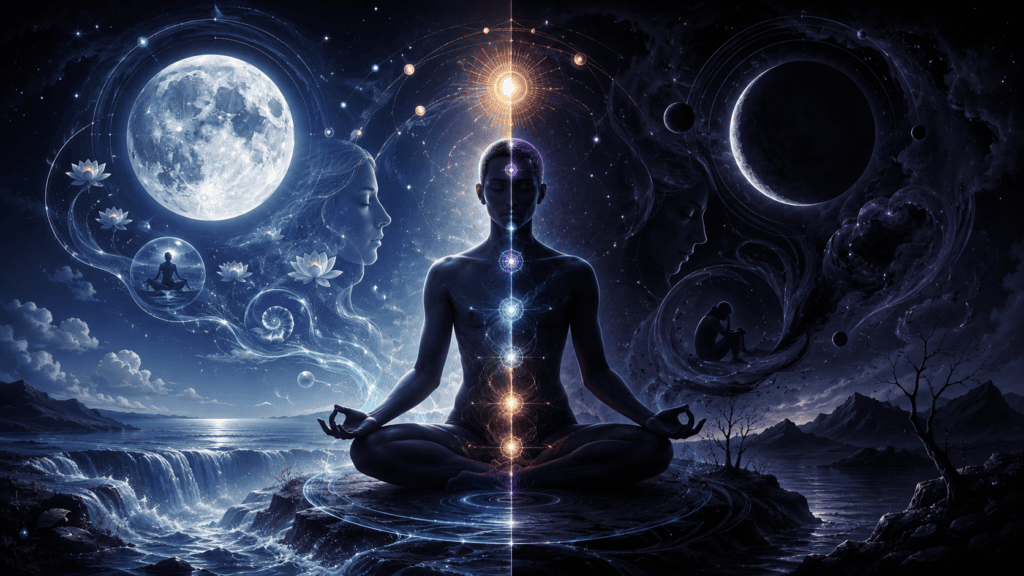
This is why both days are used for conscious decision-making, spiritual alignment, and checking one’s inner state. A peaceful person may feel more peaceful on Purnima. An angry or restless person may feel more aggression. Similarly, Amavasya may help a disciplined person go deeper, but may disturb someone already emotionally heavy.
Is Purnima Auspicious and Amavasya Inauspicious?
In simple terms, Purnima is commonly seen as an auspicious day, while Amavasya is often treated as an inauspicious day for certain external activities. But this is not absolute. Diwali or Deepavali, one of the biggest Hindu festivals, falls on Amavasya and represents good over evil, light over darkness, and divine grace.
So, the real difference is not “good day versus bad day.” It is “outward fullness versus inward depth.” Purnima supports celebration, worship, clarity, temple visits, and devotional energy. Amavasya supports reflection, ancestral duty, silence, protection, and karmic cleansing. In some beliefs, charity and offerings on Amavasya bring karmic relief, good karma, prosperity, and protection.
Some traditional restrictions include avoiding non-vegetarian food restriction, alcohol restriction, relationship restriction, and conception restriction on Amavasya. Some families also avoid plucking tulsi leaves or starting new work. These practices vary by region, family, and lineage, so they should be understood as traditional belief, not one universal rule for everyone.
Purnima Vrat, Amavasya Rituals, and Major Hindu Festivals
Many important observances are connected with Purnima. Guru Purnima, Kartik Purnima, and Buddha Purnima are major examples in the festival calendar. These days are linked with gratitude, wisdom, pilgrimage, sacred bathing, and worship.
On the Amavasya side, Deepavali is the strongest example of how a moonless night can become spiritually powerful. Many households clean the home, light lamps, worship Goddess Laxmi, and pray for prosperity. This shows that darkness in Hindu thought is not always negative. Sometimes it becomes the background where light becomes more meaningful.
For temple-going devotees, astrology followers, spiritual families, Vedic calendar followers, and energy-conscious individuals, these days are useful markers. They help plan worship, travel planning, fasting, rituals, and emotional discipline. In modern life, where people often ignore natural forces, the Moon still gives a visible reminder of rhythm, change, and pause.
A Practical Way to Use This Awareness
My practical view is simple: use Vedic wisdom, astrology, and Hindu mythology as awareness tools, not fear tools. On Purnima, use the open energy for gratitude, mantra, study, prayer, and emotional clarity. On Amavasya, reduce noise, avoid unnecessary conflict, remember ancestors, and keep the mind clean.
This approach also connects with older agricultural life, where agriculture, seasons, water, light, and lunar timing mattered. Even today, these observances can support health, emotional regulation, and spiritual discipline.
The deeper meaning of lunar influence is not that the Moon controls everything. It is that human life feels different when we live with rhythm. Purnima teaches fullness, visibility, devotion, and expansion. Amavasya teaches silence, humility, remembrance, and inner reset.
Difference Between Amavasya and Purnima
Amavasya is the new moon day, when the Moon is not visibly illuminated from Earth. Purnima is the full moon day, when the Moon appears fully illuminated. In simple English, Amavasya means new moon and Purnima means full moon.
Amavasya and Purnima Meaning in English
Amavasya is commonly translated as new moon day. Purnima is commonly translated as full moon day. Both are important tithis in the Hindu calendar and are used for vrat, puja, festival, and Panchang planning.
Opposite of Purnima
The opposite of Purnima is Amavasya. Purnima marks the brightest lunar phase, while Amavasya marks the darkest lunar phase before the next waxing cycle begins.
Power this calendar data in your app
Use DevDarsha API for tide, tithi, Panchang, festival, and calendar data as developer-ready JSON.
Start free with 2,000 API calls/month