What is Nakshatra? Meaning, Origin, and Its Role in Hindu Astrology
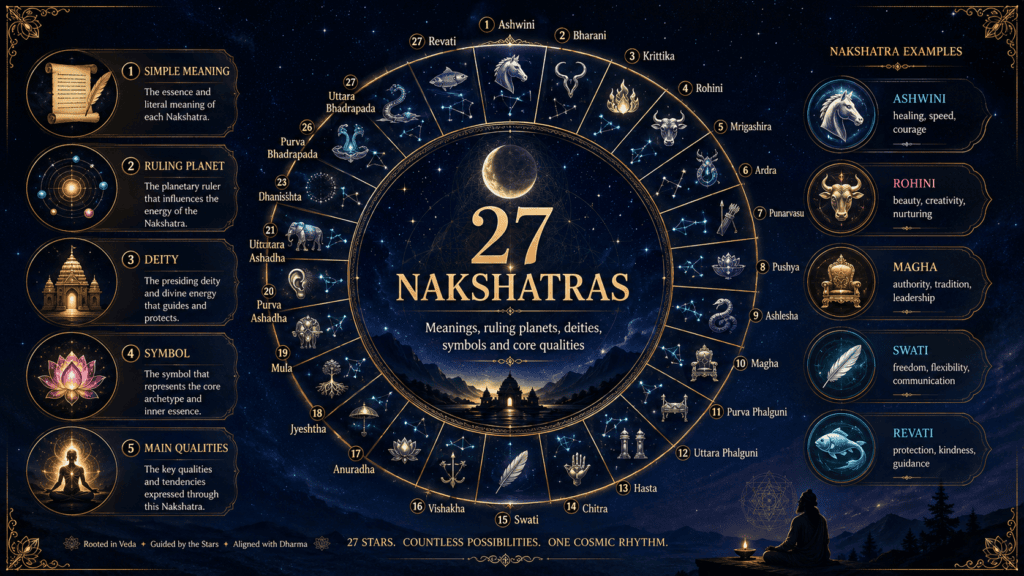
In Vedic astrology, Nakshatra means the Moon’s star-based division of the sky. The word is often linked with Naksha meaning map and Tara meaning star, so Nakshatras can be understood as a cosmic star map followed by the Moon. There are 27 Nakshatras, also called lunar mansions, spread across the 360° zodiac from Ashvini at 0° Aries to Revati at 30° Pisces. As the Moon completes its journey in about 27.3 days, each Nakshatra reflects a different energy that can influence personality, life direction, emotions, relationships, career choices, and spiritual growth.
The Meaning of Nakshatra in Vedic Astrology
When I first studied Nakshatra, the easiest way to understand it was not as a random star constellation, but as a lunar map. The word is often connected with Naksha, meaning map, and Tara, meaning star. In simple terms, Nakshatras are lunar mansions through which the Moon travels during its monthly journey.
In Vedic astrology, the zodiac is divided into 27 Nakshatras, together covering the full 360° path of the sky. Each Nakshatra spans 13°20′, starting with Ashvini at 0° Aries and ending with Revati near the end of Pisces. Because the Moon takes about 27.3 days to complete one cycle around the zodiac, these lunar divisions became an important way to understand time, nature, human behavior, rituals, personality, life direction, and the deeper karmic journey of an individual.
Origin and Mythology
The roots of Nakshatras go deep into the Vedic era texts. References appear in the Atharva Veda, Taittiriya Samhita, and Shatapatha Brahmana. Some older traditions mention 28 lunar mansions, including Abhijit, while the later and current preferred system generally uses 27 Nakshatras.
This system also connects with the old idea of a Vedic year of 12 months, 30 days, and 360 days. The small discrepancy between lunar and solar movement was handled through intercalation, or the addition of a leap month after certain cycles. The Moon’s one orbit around Earth covers an arc of about 13º 20’ per day, giving the base for the Nakshatra divisions.
In Hindu myth, the Nakshatras are often described as the daughters of Daksha and wives of Chandra, the Moon god. The story of Rohini, favoritism, curse, wax and wane, and the changing Moon’s phases gives a symbolic explanation for the Moon’s movement through the 27 nakshatra wives. This narrative makes the Nakshatra system feel less like dry astronomy and more like a living bridge between Hinduism, cosmic energies, and human experience.
Astrological Significance
A person’s Janma Nakshatra, or birth Nakshatra, is calculated from the Moon’s position at the exact date, time, and location of birth. Unlike ordinary solar days, Nakshatra calculation needs careful observation of the Moon’s degree in the zodiac.
While the zodiac sign or rashi is based on larger divisions, Nakshatra gives a more specific layer. It is used to understand personality, relationships, health, career, compatible nakshatras, and even marriage matching. In many Hindu temples, during archana offerings or puja, the pujari may ask for the devotee’s name, gotra, and Nakshatra because these details are treated as essential spiritual identity markers.
Nakshatras and Their Four Padas
Each Nakshatra is further divided into 4 Padas, also called quarters. Each Pada covers 3°20′, giving more astrological specificity. This creates 27 times 4, or 108 divisions, a number considered sacred in Hindu tradition.
The Pada adds detail to an astrological chart. It can show finer differences in individual character, behavior, destiny, personal strengths, emotional tendencies, attitudes, emotional responses, and life goals. The Pada also connects with the Navamsa chart, which is important for understanding both spiritual aspects and material aspects of life.
Characteristics of the 27 Nakshatras
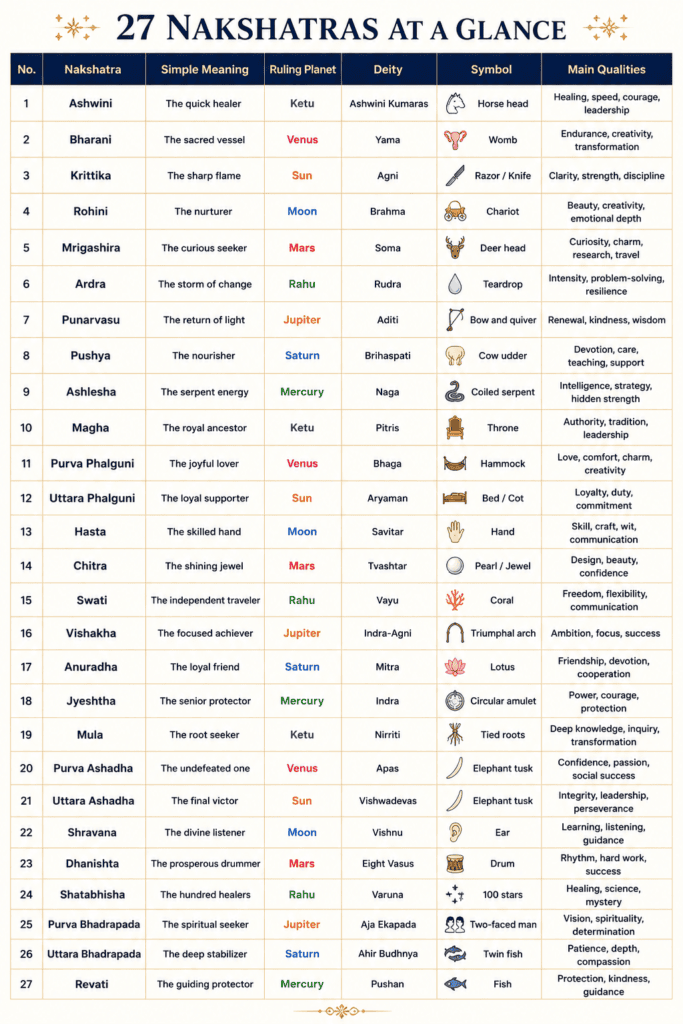
Each of the 27 Nakshatras has its own ruling planet, deity, symbolism, elemental qualities, and specific energies. This is why two people with the same zodiac sign may still behave very differently if their Moon is placed in different Nakshatras.
A Nakshatra can indicate karmic patterns, inner world, emotional well-being, relationships, career, and life path. For example, one Nakshatra may show strong leadership, another may show nurturing ability, while another may show curiosity, research ability, or artistic nature. In this way, Nakshatra becomes an intricate map of destiny and personal direction.
Psychological and Emotional Insights Through the Moon’s Nakshatra
In Vedic thought, the Moon represents the mind, emotions, memory, and instinctive reactions. That is why the Moon’s Nakshatra gives deep insight into the individual inner world, emotions, challenges, instinctive behaviors, psychological state, and mental framework.
Astrologers often study the Nakshatra to understand emotional triggers, coping mechanisms, mental health concerns, emotional growth, and personal relationships. From experience, this is one of the most practical uses of Nakshatra because it explains why a person reacts in a certain way during life’s ups and downs.
The Dasha System and Planetary Periods
The Vimshottari Dasha system is one of the most important timing methods in Vedic astrology. It is based on the Moon’s Nakshatra at birth and follows a 120-year planetary cycle. Each Dasha period is ruled by a specific planet, bringing different planetary influences into an individual’s life.
These planetary energies can shape major events, opportunities, challenges, career milestones, personal relationships, and important decisions. Astrologers use Dasha periods to understand timing, remedies, and alignment with cosmic rhythms and one’s karmic path.
Naming Conventions in Vedic Astrology
In traditional Vedic customs, naming a child was not only a family decision; it was also linked with the birth Nakshatra and its corresponding Pada. Each Pada is associated with a phonetic syllable, which may guide the first letter of the child’s name.
This practice is believed to create vibrational harmony between the person’s individual identity, cosmic order, and life path. The idea is that a name aligned with the Moon’s Nakshatra may support spiritual alignment, personal growth, success, and better resonance with universal forces.
Nakshatra and Career Path
The Moon’s Nakshatra can also help identify natural career tendencies. Along with Lagna or Ascendant, it shows a person’s external personality, life challenges, talents, inclinations, professions, and deeper life purposes.
For example, Ashwini Nakshatra, ruled by Ketu, is often linked with healing, medicine, research, alternative healing, pioneering work, and innovative approaches. Pushya Nakshatra, connected with Saturn, may show ability in nourishment, administration, organization, healthcare, teaching, and management. The Pada influence further refines career traits, occupational strengths, weaknesses, and career decisions.
Nakshatra Compatibility in Relationships
Nakshatra is widely used for relationship compatibility and marriage analysis. The Moon’s Nakshatra reveals emotional nature, mental tendencies, and the way an individual connects with partners. This is why astrologers check emotional rapport, interpersonal understanding, mental alignment, and spiritual alignment between a couple.
Traditional systems like Nakshatra Porutham and Ashtakoota matching assess eight key factors, including emotional compatibility, mutual understanding, shared values, and long-term harmony. The aim is not only a successful marriage, but a harmonious relationship, lasting relationship, and alignment of karmic paths.
Using Nakshatra for Career and Relationship Compatibility
Nakshatra gives a combined view of career paths and relationship compatibility because both depend on temperament, skills, emotional style, and values. A person with strong Mars influence may prefer action-based fields such as sports, leadership, or technical work. A person with strong Venus influence may move toward creative arts, beauty, design, or relationship-based careers.
Similarly, in relationships, one Nakshatra may bring nurturing energy, while another may bring intellectual curiosity. For example, Rohini Nakshatra is often associated with growth and comfort, while Mrigashira Nakshatra can show searching, learning, and curiosity. When these qualities are complementary, they can support a balanced relationship, fulfilling relationship, and more informed life partnerships.
How to Calculate Your Nakshatra
To calculate your Nakshatra, you need the exact Moon position at your time of birth, along with precise date, place of birth, and birth details. The zodiac belt is measured from 0° Aries through the full 360° Pisces span, and the Moon’s degree is matched with the corresponding Nakshatra.
Today, most people use software or an online calculator, but the basic idea is simple: find the Moon longitude, divide the zodiac into 27 parts of 13°20′, and identify the exact placement. This gives a person’s cosmic blueprint, showing personality, life path, karmic influences, and the deeper movement of the soul’s journey through lunar position.
27 Nakshatras in Vedic Astrology: Complete Table with Deity, Planet, Symbol, and Meaning