
Blue Moon Magnified: Detect the Rare Moon Before Everyone Else
Blue Moon is mainly a calendar-based rare Full Moon, not a color-based Moon. Its name comes from older folklore, almanac traditions, religious timing, and later modern misunderstanding. That is why the phrase “once in a Blue Moon” means something that happens rarely, but not never.
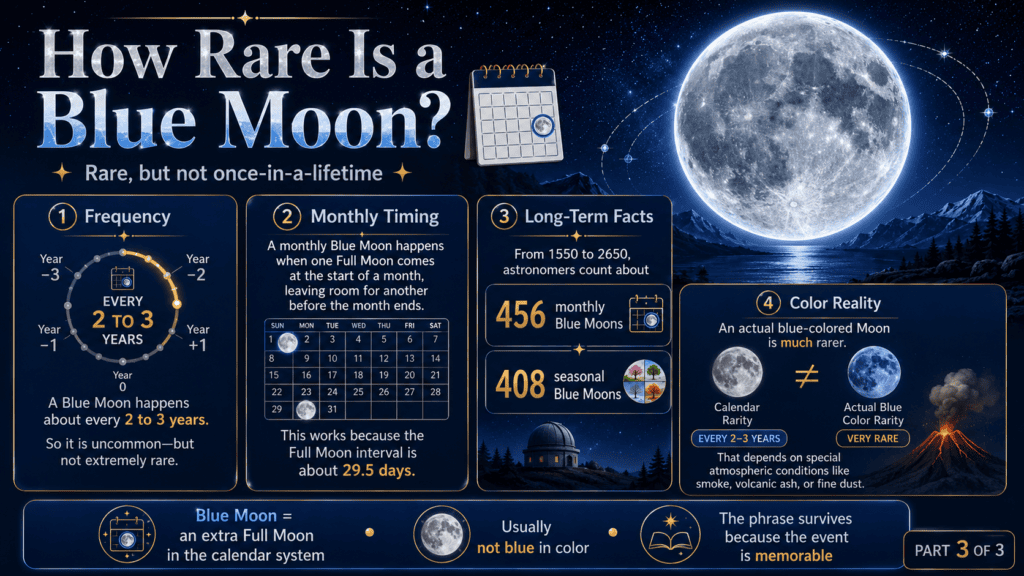
A Blue Moon is not usually a Moon that looks blue. In astronomy, it is a rare Full Moon arrangement created by the mismatch between the moon cycle and the human calendar. This is why people say once in a Blue Moon when something happens not very often, after a long time, or very rarely.
The Moon takes about 29.5 days to move through its lunar phase cycle and become full again. That means 12 full moons complete roughly 354 days, while a calendar year has 365 days or 366 days in a leap year. Because the lunar cycle is shorter than the calendar year, every two and a half years or so, an additional full moon appears. This 13th full moon is the source of the rare Moon occurrence we call a Blue Moon.
There are two main definitions. The older one is the seasonal Blue Moon: the third Full Moon in an astronomical season that has four Full Moons instead of the usual three. The modern popular one is the monthly Blue Moon: the second Full Moon in a calendar month that has two Full Moons. Both are real calendar cycle events, but they come from different systems of lunar naming and full Moon names.
Across cultures around the world, full Moons have long received names. In some Native Americans traditions and later almanac traditions, a full Moon in January might be called the Wolf Moon. These Moon phases repeat in a cycle of approximately one month, but since there are 12 months in a year and sometimes 13 full Moons, one Moon can disturb the normal naming scheme. That extra Moon was referred to as a Blue Moon.
From my own experience writing about sky events, the confusion usually starts when people hear “blue” and expect a visible color change. In most cases, a so-called blue moon is simply a special kind of full moon by definition, not by appearance. It is a celestial event based on occurrence, timing, and rarity.
What colour is a blue moon?
Most blue moons are the same colour as any other full moon. The Moon usually appears white, pale yellow, or grey Moon depending on Moon visibility, local haze, and atmospheric conditions. The Moon shade we see is shaped by light passing through Earth’s atmosphere before reaching the face of the Moon or our eyes.
In rare cases, the Moon can appear blue, but that is a separate matter from the calendar meaning. A true blue appearance can happen when fine dust particles, smoke, water droplets, or volcanic dust in the air scatter light in an unusual way. One famous example often mentioned is the volcanic eruption of Krakatoa, which exploded and sent dust, ashes, and particles into the atmosphere, producing unusual skies and reports of blue moons.
A lunar eclipse is different again. During lunar eclipses, the Moon can look blood red because sunlight bends through Earth’s atmosphere before reaching the Moon. That is why a red blue moon can happen only when a calendar Blue Moon also coincides with an eclipse. The eclipse colour is caused by shadow and filtered sunlight, not by the monthly full Moon definition. So, the lunar colour, Moon color, and blue Full Moon appearance depend on atmospheric effect, while the term Blue Moon usually depends on calendar timing.
Why Is It Called a Blue Moon?
The historical origins of the term are not perfectly settled. The origin, phrase origin, and name origin carry some mystery, ambiguity, and competing accounts. Some explanations connect the phrase to folklore, traditional usage, and a rare expression meaning something absurd or unlikely. According to folklorist Philip Hiscock, the phrase may have originated around 400 years ago, when invoking a blue Moon once meant something impossible, absurd, or something that would never happen.
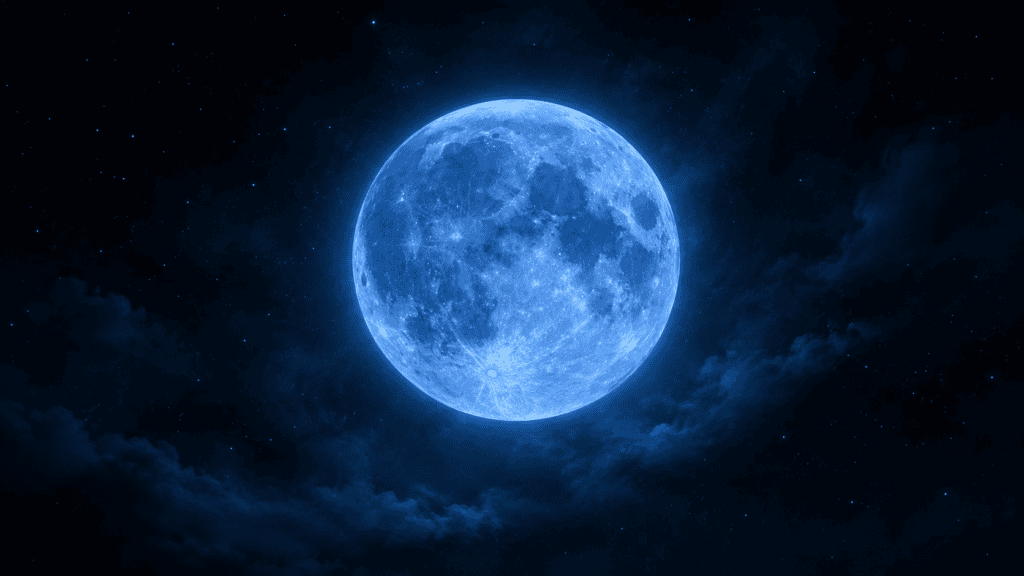
There is also a linguistic theory involving a mispronunciation of the disused word belewe, meaning betray. In that idea, an extra Moon could betray the usual idea of one full moon in each month, especially when Moon worshippers, Church authorities, or calendar keepers depended on the Moon’s position and duration to calculate Lent, Easter, and other dates.
In America, blue moons were later calculated every year in almanac systems such as the Maine Farmers’ Almanac of the 19th century and early 20th century. These systems often used the tropical year, from one winter solstice to the next, rather than simply January 1st to December 31st. The year was divided into winter, spring, summer, and fall, with Moon names such as Yule Moon, Lenten Moon, Easter Moon, Paschal Moon, and Harvest Moon tied to the time of year.
When a season had four full moons instead of three full moons, the extra one created difficulties in keeping the correct times for festivals and traditions. The rule became: call the third full moon the Blue Moon, leaving the fourth moon to keep its special names in the right place.
Origins of the Seasonal Full Moon
The seasonal Blue Moon is the more traditional definition: the third Full Moon in an astronomical season with four Full Moons. This definition is traced back to the Maine Farmer’s Almanac, a now-defunct Almanac, where the 13th Full Moon in a year could upset the usual arrangement of Church festivals and seasonal Moon names.
In older calendar thinking, the number 13 had an unlucky status, partly because it created difficulties in calculating the exact dates of holidays. The Christian ecclesiastical calendar relied heavily on Moon phases, especially for Lent and Easter. The final Full Moon of winter, the first Full Moon of spring, and other seasonal markers helped keep celebrations, customs, and proper times aligned.
This is why the traditional definition can feel like a complicated definition compared with the modern one. It uses astronomical seasons, equinoxes, solstices, the winter season, winter solstice, spring equinox, spring season, summer solstice, and each season boundary. In this astronomical calendar, the Blue Moon is not just “extra”; it protects the Full Moon sequence and seasonal naming system.
Origins of the Monthly Blue Moon
The monthly Blue Moon is simpler: the second Full Moon in a calendar month. This popular definition came from a misinterpretation that took on a life of its own.
In the July 1943 issue of Sky & Telescope, Laurence J. Lafleur of Antioch College, Ohio, discussed Blue Moons and the 1937 Maine Farmers’ Almanac. Later, in the March 1946 edition of the same astronomy magazine, amateur astronomer James Hugh Pruett of Eugene, Oregon wrote “Once in a Blue Moon.” Pruett summarized the idea as happening seven times in 19 years, when a year has 13 full moons, with 11 months having one full moon and one month having two full moons. The second in a month was then called Blue Moon.
That explanation was technically an error, but it spread through astronomy writing, radio shows, and later the StarDate radio program on January 31, 1980. It became even more familiar through the 1986 version of the board game Trivial Pursuit. By the 1980s, this second definition had become the commonly accepted meaning in modern American folklore.
Time zones add another twist. A Full Moon is full at one moment in time, but local time zone differences mean a monthly Blue Moon can fall in one calendar month in one region and a different month in another part of the globe. That is why timeanddate.com and similar sources list dates, times, seasonal Blue Moons, and monthly Blue Moons by local timing.
A good example is February 2018, when there was no full moon in February, while January and March each had blue moons in many places. Both definitions can exist in the same world, but the position, year, and different parts of the globe affect the local result.
How Rare Is a Blue Moon?
A monthly Blue Moon usually occurs when a Full Moon falls at the beginning of the month, allowing the next of the successive Full Moons to arrive before the month ends. Because the Full Moon interval is approximately 29.5 days, this can happen only in longer calendar months. The Gregorian Calendar makes it possible in most months, but not usually February.
Over a long span of 1100 years, from 1550 to 2650, calculations show about 408 seasonal Blue Moons and 456 monthly Blue Moons. So Blue Moons are rare, but not impossibly rare. In ordinary life, they occur every two or three years.
The Moon turning an actual blue shade is far less common. That depends on atmospheric conditions such as volcanic ashes, smoke, water droplets, unusual clouds, or other particles in space and air. So there are really two ideas: the astronomical rarity of the calendar event and the much rarer blue Moon appearance caused by atmosphere.
The year 2018 was unusual because it had two blue moons only two months apart, and one was linked with a lunar eclipse. A similar repeated Blue Moon year is expected next in 2037. That rhythm shows how Moon phases, lunar phases, calendar months, the Full Moon cycle, and astronomical timing keep creating this memorable rare lunar event.
Try This With Your Own City
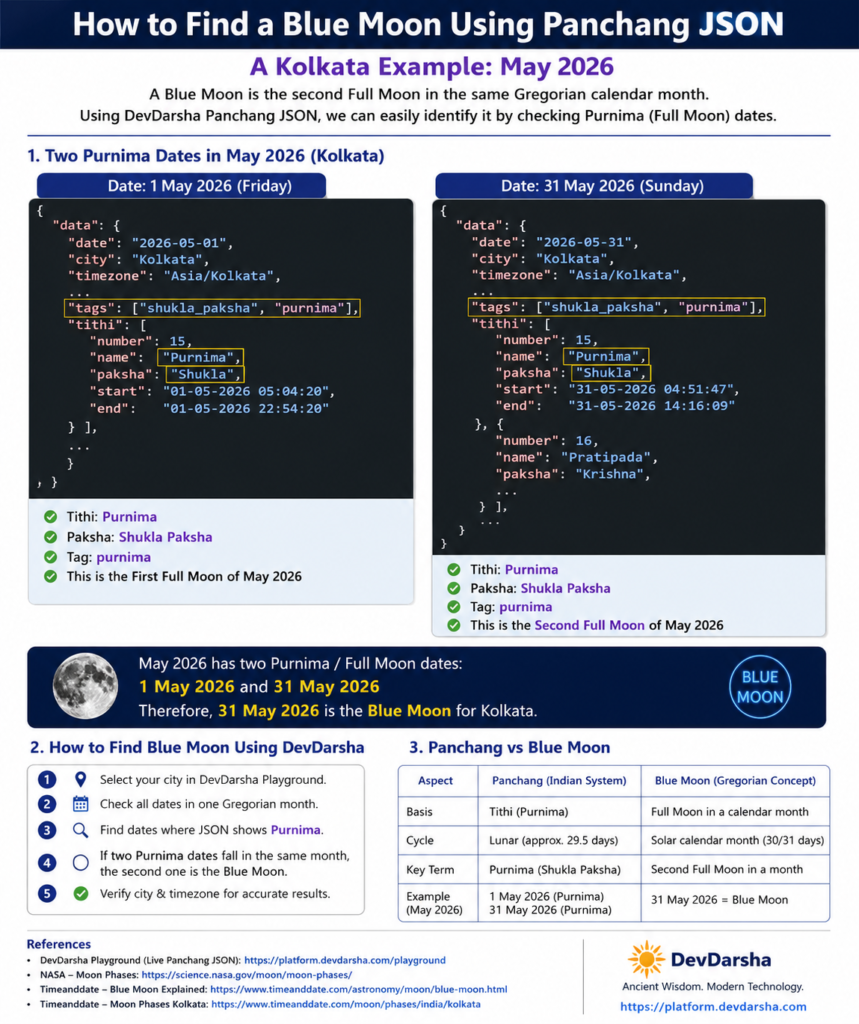
This example shows how a Blue Moon can be detected using Panchang JSON data.
In the Kolkata example, May 2026 has two Purnima / Full Moon dates:
1 May 2026 and 31 May 2026That means 31 May 2026 becomes the Blue Moon for Kolkata, because it is the second Full Moon in the same Gregorian calendar month.
With DevDarsha Panchang API, you can do the same check for any supported city FREE:
- Check a city
- Scan all dates in a month
- Find dates marked as Purnima
- Detect whether that month has two Full Moons
- Identify the second Full Moon as the Blue Moon
This can help developers, astrology platforms, calendar apps, content creators, and Panchang-based products detect:
- Next Blue Moon
- Previous Blue Moon
- City-wise Full Moon dates
- Purnima-based calendar events
- Lunar month patterns from JSON
Explore the live playground here:
https://platform.devdarsha.com/playground
DevDarsha API brings traditional Panchang intelligence into clean, developer-friendly JSON.
Frequently Asked Questions (FAQ)
FAQ
What is a blue moon?
A blue moon is a special full moon event. In simple terms, what is a blue moon means either the second full moon in one calendar month or the third full moon in a season that has four full moons. This definition is based on calendar timing, not Moon color. The phrase comes from the mismatch between the lunar cycle and the human calendar.
What is the blue moon meaning in English?
The blue moon meaning in English usually means something rare. That is why people say once in a blue moon when something happens very rarely. The phrase does not usually mean the Moon becomes blue.
Is blue moon really blue?
Usually, no. Is blue moon really blue is one of the most common questions. A normal Blue Moon looks like an ordinary full moon—white, yellowish, or slightly orange near the horizon. A real blue moon color can happen only in rare atmospheric conditions, such as smoke, volcanic ash, or dust scattering light unusually.
What are the blue moon types?
There are two main blue moon types: monthly blue moon and seasonal blue moon. A monthly blue moon is the second full moon in one calendar month. A seasonal blue moon is the third full moon in an astronomical season that has four full moons.
What is a monthly blue moon?
A monthly blue moon happens when there are two full moons in one month. For example, if a full moon occurs on the 1st or 2nd day of a long month, another full moon can occur near the 30th or 31st day.
What is a seasonal blue moon?
A seasonal blue moon happens when an astronomical season has four full moons instead of the usual three. In that case, the third full moon of that season is called the Blue Moon.
How often does a blue moon occur?
If you ask how often does a blue moon occur, the usual answer is about every two-and-a-half to three years. It is rare, but not impossible. That is why the phrase once in a blue moon became popular.
How rare is a blue moon?
How rare is a blue moon depends on the definition. A calendar-based Blue Moon appears every few years. A Moon that actually looks blue is much rarer and depends on atmospheric effects, not astronomy.
When is the next blue moon?
As of June 7, 2026, the next blue moon is expected to be the seasonal Blue Moon on May 20, 2027. The next monthly Blue Moon after the May 31, 2026 event is expected on December 31, 2028.
When was the last blue moon?
As of June 7, 2026, when was the last blue moon points to May 31, 2026, which was a monthly Blue Moon because May 2026 had two full moons.
What are the important blue moon dates?
Important blue moon dates include August 30–31, 2023, August 19, 2024, May 31, 2026, May 20, 2027, and December 31, 2028. Dates can vary slightly by time zone, so local moon calendars should be checked for India-specific timing.
What happened during blue moon 2023?
The blue moon 2023 event was a famous super blue moon. It was a monthly Blue Moon and also a supermoon, making it widely discussed worldwide.
What was the blue moon 2023 in India time?
The blue moon 2023 in India time occurred on August 31, 2023, because the full moon moment was at 03:36 UTC on August 31, which converts to about 9:06 AM IST.
Was there a blue moon 2024?
Yes. Blue moon 2024 refers to the August 19, 2024 seasonal Blue Moon. It was also widely called a Super Blue Moon in public coverage.
What is blue moon in India?
Blue moon in India means the same astronomical event, but the date and visible time can shift because India follows IST. For skywatching, the best practical viewing time is usually around local moonrise on the night closest to the full moon.
What was the today blue moon time?
For today blue moon time, first check whether today is actually a Blue Moon date. As of June 7, 2026, today is not a Blue Moon date. The recent Blue Moon full phase was on May 31, 2026, at about 2:15 PM IST.
What is a super blue moon?
A super blue moon happens when a Blue Moon is also a supermoon. In simple words, what is a super blue moon means a full moon that is both calendar-rare and near enough to Earth to appear slightly larger and brighter.
What is the difference between blue moon super moon and super blue moon?
Blue moon super moon and super blue moon usually refer to the same combined event: a Blue Moon that is also a supermoon. A full moon blue moon super moon is rare because three ideas meet together: full moon phase, Blue Moon calendar timing, and supermoon distance.
What was super blue moon 2023?
Super blue moon 2023 was the August 30–31, 2023 event. It was called a super blue moon because it was both a monthly Blue Moon and a supermoon.
Was the super blue moon India visible?
Yes, the super blue moon India event in 2023 was visible from India, weather permitting. In India, the full moon timing fell on August 31, 2023 morning IST, while the best visual experience was around moonrise on the nearby evening.
What is a full moon?
A full moon happens when the Moon is opposite the Sun from Earth’s perspective, so the visible lunar disk appears fully illuminated. It is one of the main phases of the moon.
What is full moon this month?
Full moon this month depends on the current month and location. For June 2026, the next full moon after the May 31 Blue Moon is the June 29, 2026 full moon.
What is a full moon calendar?
A full moon calendar lists every full moon day in a year, including special labels such as Blue Moon, supermoon, micromoon, lunar eclipse, and traditional full moon names.
What is moon phase today?
Moon phase today means the current visible shape of the Moon. The main phases are new moon, waxing crescent, first quarter, gibbous moon phase, full moon, waning gibbous, last quarter, and waning crescent. The Moon moves through these phases in about a 29.5-day cycle.
What is a new moon or no moon day?
A new moon is the phase when the Moon is between Earth and the Sun, so the illuminated side faces away from us. In common Indian usage, this is often called no moon day or Amavasya.
Are blue moon pictures actually blue?
Most blue moon pictures, blue moon images, blue moon pics, or a blue moon photo show a normal-looking full moon. Many edited images make the Moon blue for artistic effect. A real picture of blue moon color is uncommon and usually linked to atmospheric smoke, dust, or ash.
Is a blue moon the same as a lunar eclipse?
No. A lunar eclipse happens when Earth’s shadow falls on the Moon. A Blue Moon is based on full moon timing in a month or season. A blue moon lunar eclipse can happen only when both events coincide.
What is a blood moon?
A blood moon usually means a total lunar eclipse where the Moon looks reddish. The red color comes from sunlight filtered through Earth’s atmosphere.
What is blue moon blood moon?
A blue moon blood moon means a Blue Moon that also occurs during a lunar eclipse, making it both calendar-rare and visually dramatic.
What is a supermoon?
A supermoon is a full moon that occurs when the Moon is near its closest point to Earth. It can appear slightly bigger and brighter than usual.
When is the next supermoon?
The next supermoon depends on the current year’s lunar distance calendar. In 2026, notable supermoons occur later in the year, including November 24 and December 23.
What are the important moon events 2026?
Important moon events 2026 include the May 31 monthly Blue Moon, two lunar eclipses, multiple micromoons, and later-year supermoons. The year 2026 has 13 full moons, including a Blue Moon, three micromoons, three supermoons, and two lunar eclipses.
What is out of the blue moon meaning?
Out of the blue moon meaning is usually a confused mix of two phrases: “out of the blue” and “once in a blue moon.” “Out of the blue” means suddenly or unexpectedly. “Once in a blue moon” means very rarely.
What is blue moon meaning in love?
Blue moon meaning in love is not an official astronomy term. In emotional or poetic use, it can suggest a rare love, an unexpected meeting, or a relationship that feels unusual and special.
Is blue blood idiom related to blue moon?
No. The blue blood idiom means aristocratic or noble family background. It is not related to Blue Moon astronomy.
What is true blue meaning?
True blue meaning is loyal, faithful, or genuine. It is an English idiom and is not directly connected to a Blue Moon.
What is moon definition?
A simple moon definition is: a natural satellite that orbits a planet. Earth has one Moon, and its changing sunlight pattern creates the visible moon phases.
What is astronomy definition?
A simple astronomy definition is: the scientific study of celestial objects such as stars, planets, moons, galaxies, eclipses, and other space events.
What is lunar month meaning?
Lunar month meaning refers to the time the Moon takes to complete one phase cycle, from one new moon to the next or one full moon to the next. This cycle is about 29.5 days, which is why Blue Moons can happen.
How many full moons in a year?
Most years have 12 full moons, but some years have 13. When there are 13 full moons, one of them may become a monthly or seasonal Blue Moon depending on how the dates fall.