
The Science Behind Ekadashi Fasting: Ancient Wisdom, Intermittent Fasting, and Health Benefits
Discover the scientific logic behind Ekadashi fasting. Learn how this ancient Hindu tradition relates to intermittent fasting, digestive health, metabolic balance, mental clarity, and spiritual well-being.

The Intent Behind Writing This Article
My understanding of Ekadashi did not begin in a book. It began at home, watching elders treat this day with quiet seriousness. As a child, I only knew that grains, rice, lentils, and heavy food were avoided. Later, while studying Hindu calendar, Panchang, lunar calendar, and traditional fasting logic, I realized that Ekadashi fasting is not merely a ritual. It is a carefully placed fasting practice between food discipline, spiritual discipline, and body rhythm.
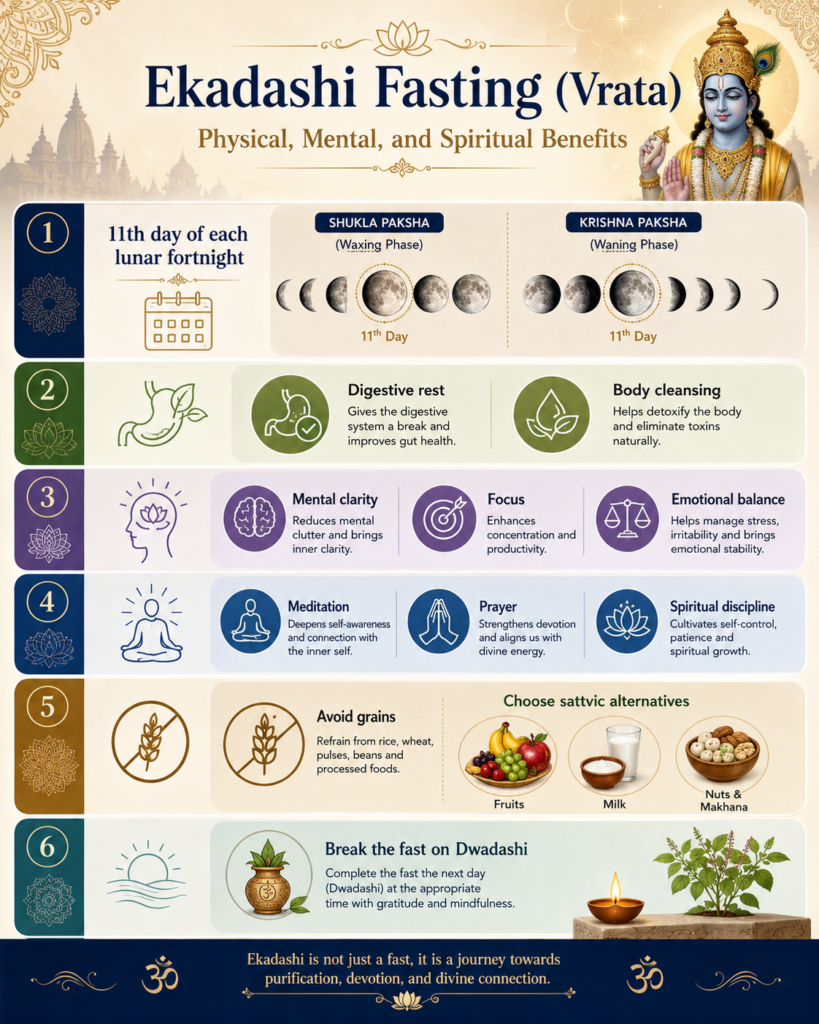
Ekadashi Vrata falls on the eleventh day of each lunar fortnight: once in Shukla Paksha, the waxing moon, and once in Krishna Paksha, the waning moon. This creates nearly twenty-four Ekadashis in a year.
Scientific Importance of Observing a Fast on Ekadashi
The ancient view connects moon cycle, lunar phases, new moon, full moon, Amavasya, Purnima, Dwadashi, sun, moon, earth, gravity, and atmospheric pressure with the condition of the human body. Just as ocean tides, tidal waves, high tides, rough waves, and calm waves respond to the lunar pull, the body, filled with body fluids, body water, and natural fluids, may also respond subtly.
Traditional teachers explained this through Vedic astronomy, moon position, orbital paths, Earth rotation, celestial motion, magnetic pull, moon pull, lunar attraction, and tidal influence. Whether one reads this literally or symbolically, the practical lesson is clear: the body performs better when eating follows rhythm, restraint, and timely rest.
What Is Ekadasi Thithi?
Ekadasi Thithi means the 11th day of the lunar phase. A Thithi is not always equal to 24 hours because it depends on the angular relationship of the moon, Earth, and solar position, traditionally measured in divisions of about 12.41 degrees. This is why devotees follow Panchang timing rather than only the civil date.
Scientific Reason on What Happens to the Human Body During Ekadashi?
During Ekadashi fasting, the digestive system gets a pause. Less food intake means less burden on the stomach, liver, kidney, bowel, gut, intestinal tract, glands, and cells. This supports digestive rest, body cleansing, bowel cleansing, internal cleansing, physical cleansing, body refreshment, and body recovery.

When the body is overloaded with solid foods, processed food, and unhealthy food, there may be toxic accumulation, undigested food, toxin formation, digestive disruption, and reduced mental performance. A lighter Ekadashi diet can help the brain, memory, thinking ability, decision-making capacity, and cognitive function feel clearer.The Science Behind Ekadashi Fasting (Vrata): Ancient Wisdom, Intermittent Fasting, and Health Benefits
Physical Benefits of Fasting on Ekadashi
The main physical benefits include detoxification, cleansing, toxin elimination, better liver function, cellular repair, cellular rejuvenation, body repair, and body renewal. A sensible fast may support digestive efficiency, digestion improvement, digestive enzymes, gut health, gut microbiota, nutrient absorption, metabolism, metabolic balance, metabolic regulation, and energy utilization.
It also encourages calorie restriction, lower calorie intake, use of stored fat, weight management, weight loss, and weight regulation. Some people connect this with intermittent fasting, fortnightly fasting, 36 hours fasting, ketosis, ketones, triglycerides, and energy metabolism. Still, complete fasting or Nirjala Upvaas is not for everyone. Those with diabetic profile, hypertension control concerns, kidney disease management, reproductive health, fatigue, headaches, asthma symptoms, wheezing, or nocturnal cough should take proper fasting guidance.
Scientific Reason on Why to Fast on Ekadashi and How It Helps Our Health?
The health logic is simple: stop constant loading, allow repair. A day of light eating, sattvic meals, pure food, fruits, milk, and non-grain foods can support immune system, strengthened immunity, immune strengthening, illness protection, vitality, wellbeing, hormonal balance, bodily function, circadian rhythm, circadian clock genes, oxidative stress reduction, inflammation reduction, disease resistance, longevity, and wellness.
Some modern interpretations mention Junk DNA, non-coding DNA, gene expression, genetic regulation, DNA preservation, and biological repair. These claims should be handled carefully, but the broader principle remains valuable: disciplined fasting helps the body conserve body resources and return to balance.
Spiritual Benefits of Fasting on Ekadashi
The deeper meaning of Upavas or Upawas is not only food abstinence. It means closeness to God and divine proximity. That is why Ekadashi is linked with Lord Vishnu, Lord Krishna, Supreme Lord, Bhagavad Gita, Bhagavatam, devotees, Vaishnavas, bhakti, devotion, worship, prayer, meditation, service, and devotional service.
The fast supports purification, mind purification, spirit purification, consciousness cleansing, heart purification, soul cleansing, self-reflection, introspection, contemplation, surrender, humility, commitment, divine love, divine blessings, divine grace, guidance, and protection.

Fasting on Ekadashi Will Help You on Improving Your Mental Wellbeing
In my own experience, Ekadashi feels most powerful when the stomach is light and the mind is not scattered. The day naturally supports mental wellbeing, mental clarity, focus, concentration, heightened awareness, self-awareness, mindfulness, conscious fasting, self-observation, self-regulation, and mindful living.
It also trains willpower, resilience, discipline, determination, mental fortitude, mental strength, mental discipline, self-control, behavioral control, self-mastery, emotional balance, emotional awareness, emotional healing, emotional resilience, inner peace, inner harmony, positive mindset, and clarity of thought.
What Is the Significance of Avoiding Grain Food on Ekadashi?
Traditional rules advise grain avoidance, especially grain food, grains, rice, and certain forbidden food. Spiritually, this is connected with reducing sinful activity, sinful desire, sinful thinking, sinful feeling, sinful acting, sinful tendencies, sinful reactions, papa buddhi, Mahapapa, and karmic burden.
Practically, avoiding dense grain-based meals may reduce water retention, hydration load, and digestive heaviness, supporting bodily balance, mental clarity, digestive health, purity of mind, and sacred fasting.
How Is Ekadashi Observed?
Ekadashi observance may include fasting, dietary restrictions, fruits, milk, non-grain foods, chanting, holy names, Holy Name, Hare Krishna Maha Mantra, darshan, Lord worship, scripture reading, spiritual learning, religious practice, religious fasting, fasting ritual, sacred observance, and spiritual activities.
What Is the Pastime Behind Ekadashi?
The Ekadashi pastime speaks of Mura Rakshasa, a demon, the Devatas, sages, divine battle, divine intervention, divine power, dharma, world protection, victory, defeat of evil, good over evil, spiritual triumph, and victory celebration. Read inwardly, it is the story of defeating inner disorder.
What Is the Significance of Chanting the Hare Krishna Mantra on Ekadashi?
The Hare Krishna mantra on Ekadashi is seen as a meritorious act. Mantra meditation, sacred sound, divine remembrance, nama bhajana, and Krishna consciousness deepen spiritual upliftment, spiritual cleansing, inner transformation, grace, faith, purity, consciousness, and liberation.
What Should One Do on Ekadashi?
Keep the day simple: reduce excess speech, avoid indulgence, practice meat avoidance, alcohol avoidance, read Srimad Bhagavad Gita, remember jiva-atma, seek moksha, salvation, ultimate truth, wisdom, human purpose, spiritual growth, divinity, and a more natural state of living.