Purnimanta vs Amanta: Why Hindu Month Dates Differ Across India?
When I first tried to understand Amanta vs Purnimanta, the confusing part was not the Moon, Tithi, or festival dates. The real confusion was this: how can two people follow the same Hindu calendar, observe the same lunar phases, celebrate the same Diwali or Janmashtami, and still say they are in different months?
The answer is simple once we stop looking at the calendar like a fixed wall chart and start reading it as a living lunar month system.
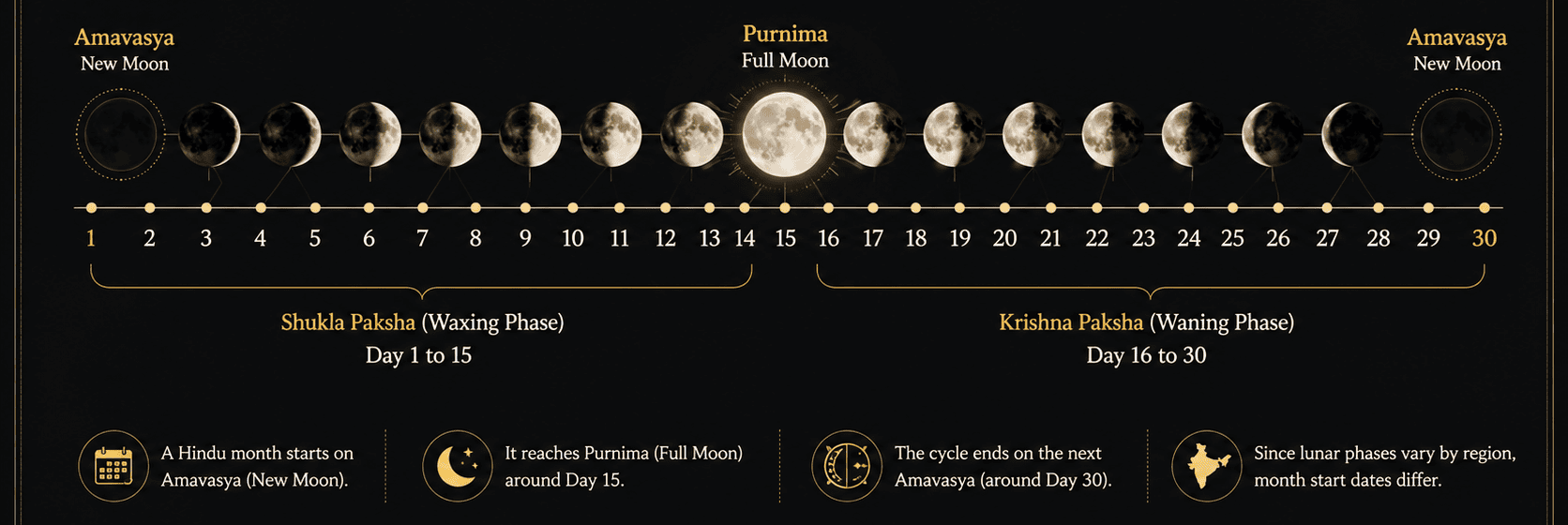
Both systems are based on the lunar cycle, which is about 29.5 days. The Moon completes its visible cycle around Earth, moving from New Moon to Full Moon and back again. In the Hindu lunar calendar, this full cycle becomes the basic unit of time tracking, measurement, and traditional timekeeping.
A Hindu lunar month is divided into two halves:
- Shukla Paksha (waxing moon) – New Moon to Full Moon
- Krishna Paksha (waning moon) – Full Moon to New Moon
These two fortnights are also called the Bright Half and the Dark Half. In Shukla Paksha, the moon growing phase begins after Amavasya. In Krishna Paksha, the Moon starts shrinking after Purnima.
The Primary Difference
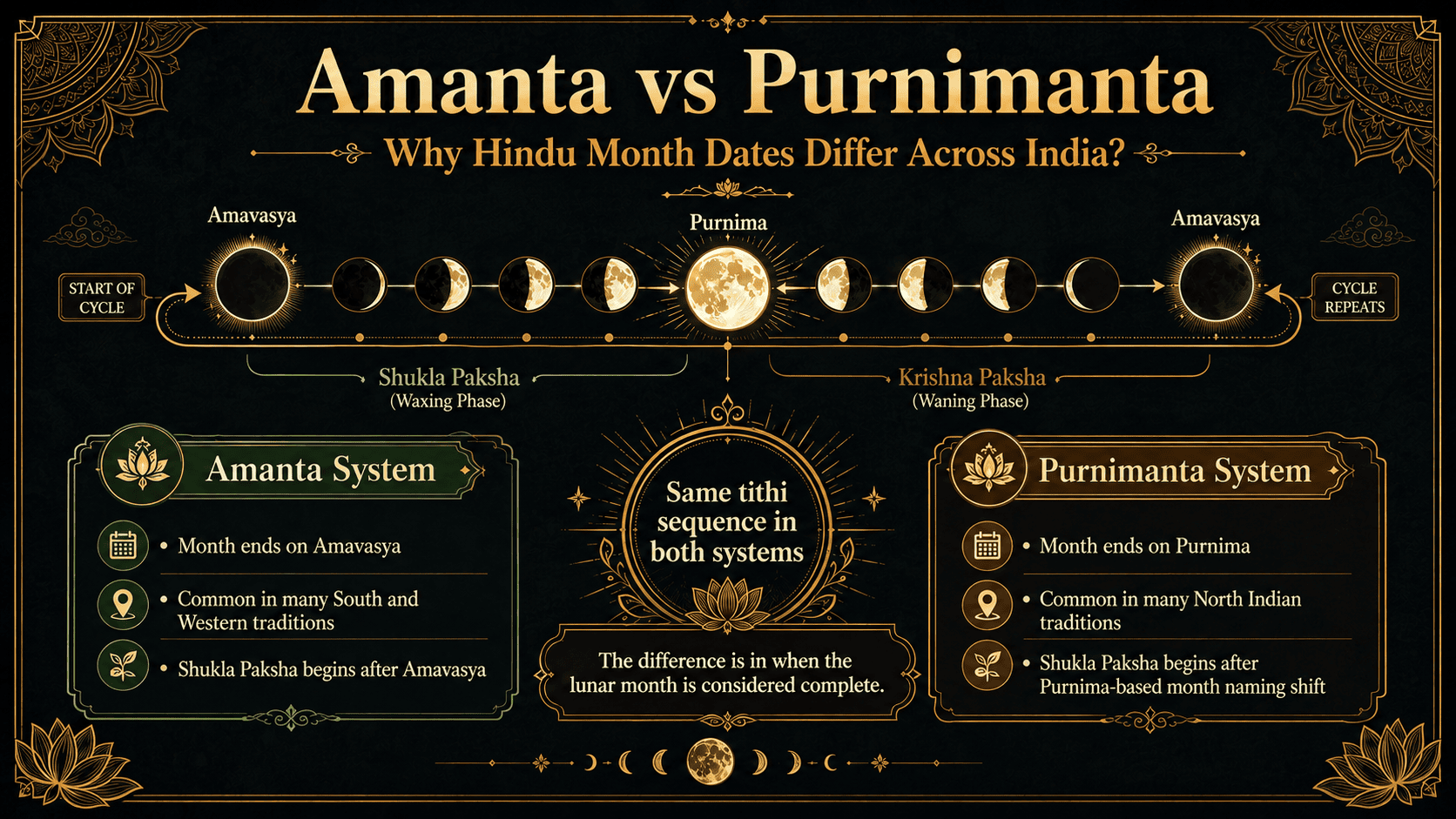
The primary difference between Amanta and Purnimanta is not the Moon itself. The celestial rhythms remain the same. The difference is where people decide the month ending happens.
Amanta means Amavasya + ant = ending on Amavasya. So, in the Amanta Lunar Hindu calendar, the month ends on the no moon day, also called Amavasya or Amavasyant. The next month begins with the first day of Shukla Paksha, when the first sliver of the Moon appears after the new moon.
Purnimanta means Purnima + ant = ending on Purnima. In the Purnimanta Lunar Hindu Calendar, the month ends on the full moon day, called Purnima or Purnimant. The next month begins with Krishna Paksha, the waning phase after the full moon.
So the same lunar month has two valid ways of being counted. One starts after New Moon, and the other starts after Full Moon.
Same Moon, Different Month Name
This is where many learners get stuck. The Tithi usually remains the same, but the name of the month can differ by about 15 days.
In the Amanta system, the month starts with the Bright Half.
In the Purnimanta system, the month starts with the Dark Half.
That means the two calendars often share one half of the month, but label the other half differently. It is almost like two people reading the same book, but one starts the chapter from the first page and another starts from the middle. The story is identical, but the chapter label changes.
For example, Deepavali falls on Ashwin Amavasya in the Amanta system. It marks the end of Ashwin, and Kartika begins the next day. In the Purnimanta system, the same day falls within Kartika, because Kartika already started after the previous Full Moon.
The festival remains on the same Tithi. The month name changes.
North vs South Indian Calendar Difference
The North vs South Indian calendar difference is mainly a regional tradition of month counting.
The Purnimanta system is followed more in North Indian states such as Uttar Pradesh, Bihar, Rajasthan, Punjab, Haryana, Himachal Pradesh, Uttarakhand, Madhya Pradesh, Chhattisgarh, Jharkhand, Jammu and Kashmir, and parts of Orissa.
The Amanta tradition is more common in Western states and Southern states, including Maharashtra, Gujarat, Karnataka, Andhra Pradesh, Kerala, Tamil Nadu, and also regions such as West Bengal, Tripura, and Assam in their local calendar traditions.
This is why a person from Delhi and a person from Pune may speak differently about the same holy month. Imagine Rahul in Delhi saying Shravan starts after the Full Moon in July, while Aditya in Pune reads his Marathi months through the Amanta method after New Moon. Both are not wrong. They are following different systems used by different regions.
Why Major Festivals Usually Stay on the Same Day
A very important point is that major Hindu festivals are usually not decided by the month name alone. They are decided by the correct Tithi, local sunrise rules, and sometimes regional ritual rules.
That is why Diwali, Janmashtami, and many major festivals are celebrated on the exact same night by people following both systems. The Bright Half and Dark Half may be labelled under different month names, but the actual lunar event remains fixed.
This is the beauty of the Hindu calendar. The outer language may differ, but the inner astronomy stays steady.
The Amanta Mystery
I once heard a Gujarati businessman explain Amanta logic in a very practical way. He said the month ending on New Moon feels like a clean reset. The sky goes dark, the cycle is complete, accounts are closed, and then life starts fresh with the new lunar light.
That idea fits many trading and regional customs in Gujarat and Maharashtra. The New Moon becomes a natural point of renewal, a kind of cultural and astronomical reset. It is easy to understand why this became strong in some regions.
The Purnimanta system, on the other hand, carries an older ritual rhythm. It is often connected with the Vedic age, early scriptures, and traditional rituals, where the light of full moon marked completion.
Both are scripturally recognized. Both are valid. Both are still widely practiced today.
Why These Differences Matter
These differences are not just technical details for astrologers. They matter for planning, trip schedules, family event dates, local fairs, temple observances, and regional rituals.
If someone follows the wrong system, they may think a month or observance is 15 days early or late. For a traveller, this can affect the experience of a local festival. For a family, it can create confusion during fasts, vows, and traditional ceremonies.
This is why knowing whether a calendar is Amanta or Purnimanta works like a cultural navigator. It helps us respect the local Desi rhythm instead of forcing one calendar habit onto all of India.
Two Sides of a Single Coin
The more I studied these systems, the more I felt that Amanta and Purnimanta are like two sides of a single coin. One sees completion in the rebirth after new moon. The other sees completion in the fullness of Purnima.
Both reflect India’s deep connection with celestial cycles, lunar calendars, solar adjustment, regional identities, and the diversity of cultures across the world. They show how human civilization has always used calendars to organize the passage of time and mark significant aspects of life.
So when you check a Hindu date, first ask: is the moon growing or shrinking? Is the month counted from Amavasya vs Purnima? Are you reading a North Indian or South Indian style calendar?
Once you know where you stand in this great Indian cycle, the Amanta and Purnimanta divide no longer feels confusing. It feels like a symphony, a vibrant rhythm of the same sky being interpreted differently by our ancestors. Same Moon, different beautiful stories.